
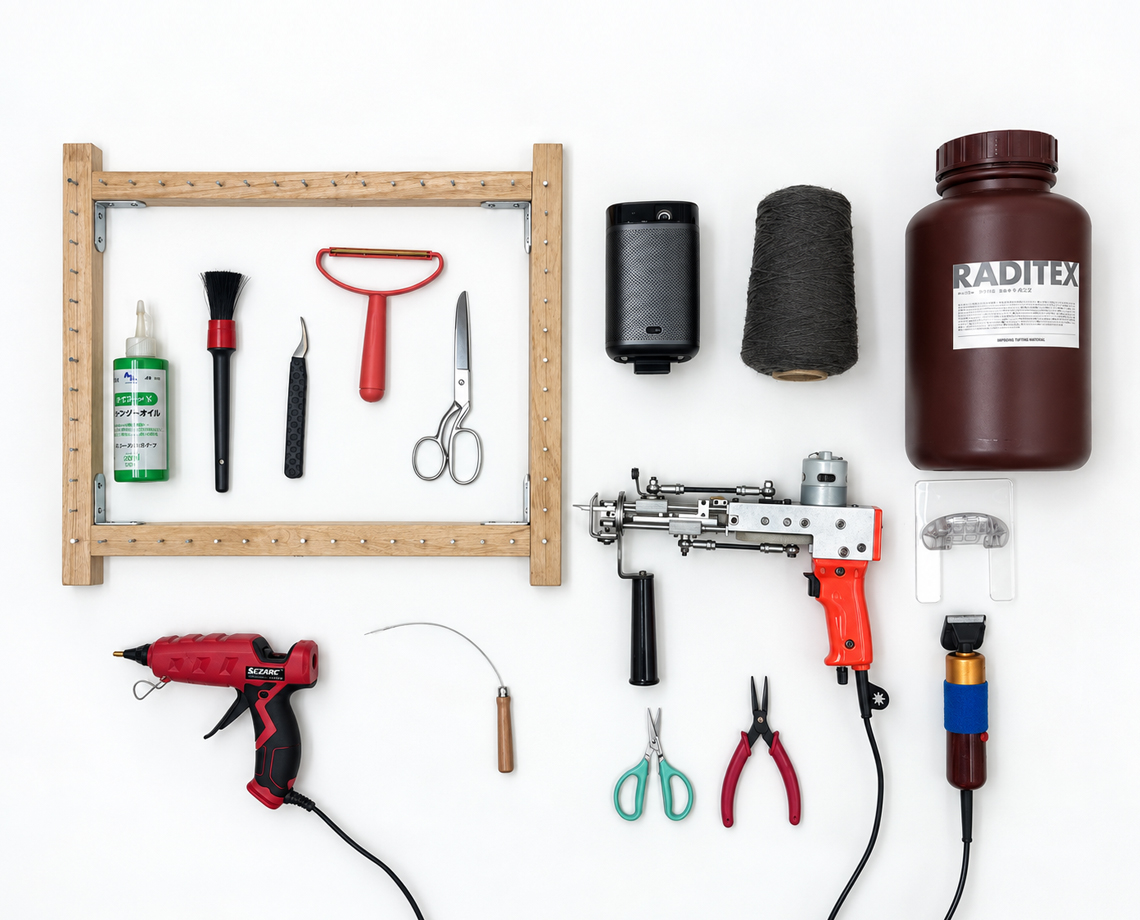
To start tufting, you need five things: a tufting gun, a frame, tufting cloth, yarn, and glue.
- 01Tufting gunThe tool that shoots the yarn in
- 02FrameThe frame you stretch the cloth on
- 03Tufting clothThe base cloth you tuft into
- 04YarnThe material you tuft with
- 05GlueWhat you use to fix the yarn and finish the back
01 How a tufting gun works, and its parts
Put simply, it works much like a sewing machine. Yarn threaded through the needle at the tip of the gun is punched into the tufting cloth. When you switch the power on and pull the trigger, the needle moves and the yarn goes in.
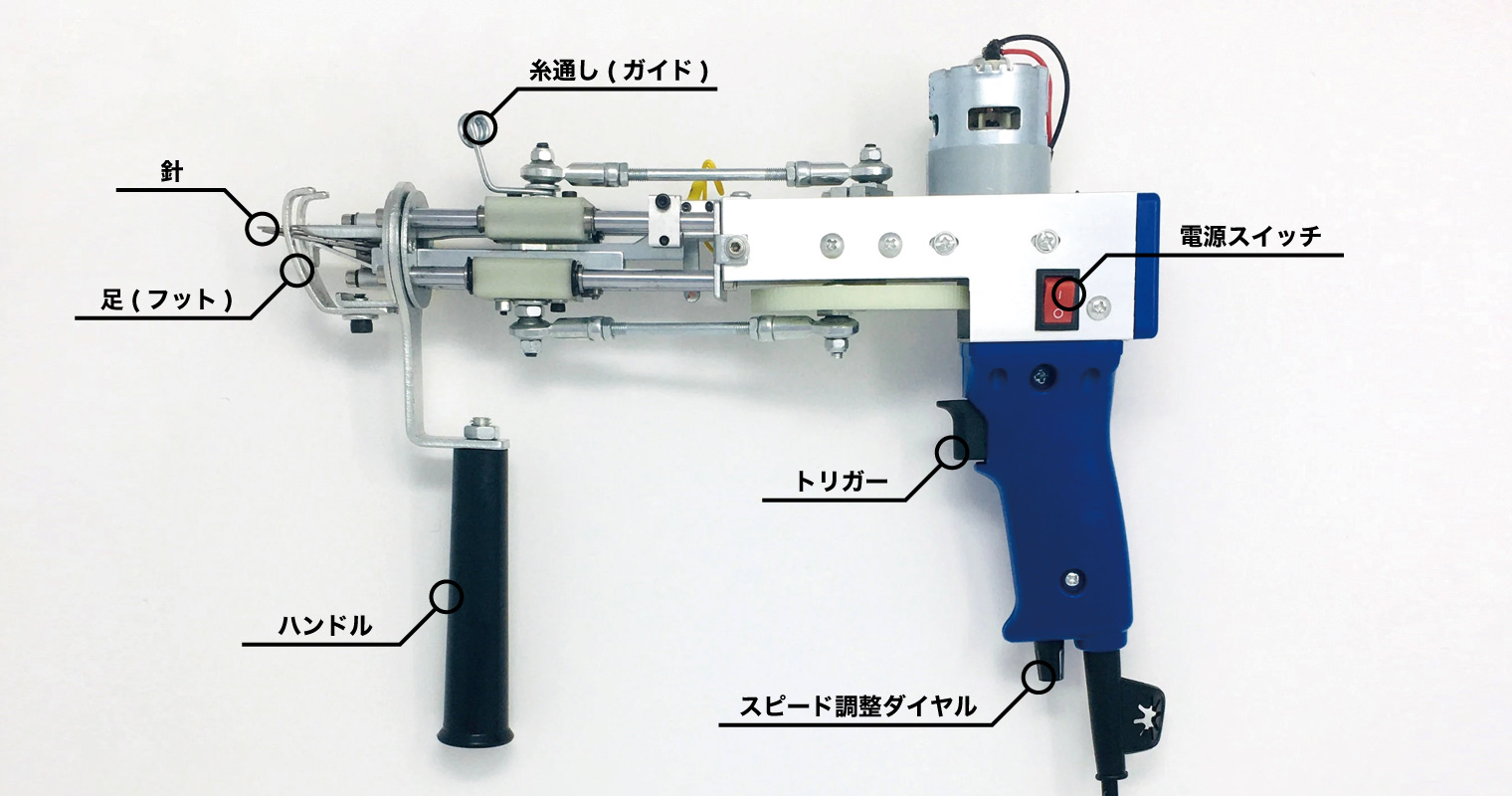
- Yarn guide
- Thread the yarn through here first, then through the needle.
- Needle
- The part that actually punches the yarn into the cloth. What's inside it differs by model, and that difference is what makes a gun cut pile or loop pile (see below).
- Foot
- Does the same job as the presser foot on a sewing machine.
- Handle
- Turns a full 360 degrees, whichever way the gun is facing.
- Trigger
- Pull it to shoot the yarn in.
- Power switch
- Keep it off whenever you are not tufting, to prevent accidents.
- Speed dial
- Adjusts how fast the gun tufts.
02 Cut pile and loop pile
There are several tufting gun models, such as the AK-1, AK-2 and AK-5, but they fall into two main types: cut pile and loop pile.
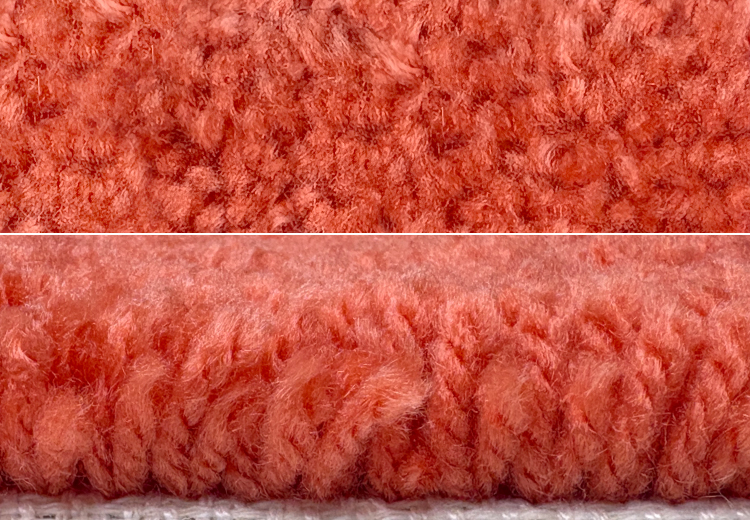
- Cut pile
- A small blade housed inside the needle comes out and cuts the yarn once it is in the cloth. The tips end up an even length, giving a soft, fluffy surface.
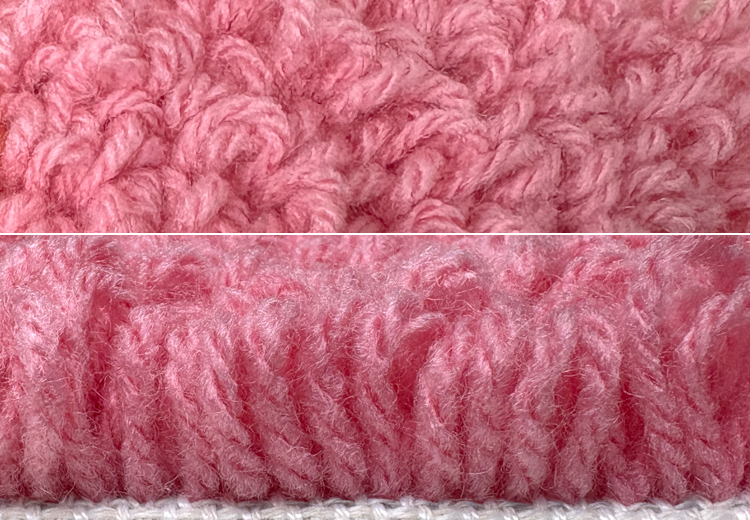
- Loop pile
- A hook-like part inside the needle feeds the yarn out. The yarn isn't cut but stitched in one continuous line, so the loops stay intact.
03 Frames and tufting cloth
Many people build their own frame, but you can also buy one online. All you need to make one is some lumber and a staple gun.
When choosing the size, allow about 10 cm of margin around the piece you want to make. The edges of the cloth are fixed to the frame, so you can’t tuft right up to the inside edge of the frame. Without enough margin, you can’t tuft right to the edges of your design, and your rug ends up smaller.
How you stretch the cloth makes a big difference to the result. Stretch it tight enough that it makes a sound when you flick it, and keep the weave running straight up and across. We explain both points in detail in step 01 of Making a rug in 5 steps.
How to make a frame (external links)
- How to make a tufting frame (in Japanese)
- Neutuft (note)
- How to make a tufting frame (in Japanese)
- RUGMATAG (blog)
- Making a tufting frame (in Japanese)
- ununu (YouTube)
- Let's build a tufting frame from scratch (in Japanese)
- Imasara Hitasura (YouTube)
- I made a tufting frame (in Japanese)
- Boku no Douga (YouTube)
04 What to watch out for when choosing a gun
We recommend buying from sellers based in Japan. If something goes wrong, it is much easier to sort out with them.
We learned this the hard way. We bought a cheap tufting gun from a third-party seller on a major online marketplace, and it didn’t work at all. We then spent about a month going back and forth with the seller, who was based overseas, to return it and get a refund.
Because of how they are made, tufting guns tend to vary from one unit to the next, even within the same model. So we can’t point to any brand or model and say it’s a safe bet. That is exactly why choosing who you buy from is the most practical way to reduce the risk.
Where to buy tufting tools05 What you don’t need to buy at first
The more you read about tools, the harder it is to decide. When you are just starting out, these can safely wait.
- Electric trimmer or clippers
- As long as the areas you trim are small, scissors will do.
- Projector
- Projectors aren't cheap. We recommend practicing straight lines and curves first, or drawing your design freehand and tufting that.
- Yarn in lots of colors
- The more colors you use, the more often you have to rethread the gun, and the messier your workspace gets. We recommend starting with 3–4 colors.
FAQ
Where can I buy a tufting gun?
We recommend buying from a seller based in Japan. Tufting guns can vary quite a bit from one unit to another, so it helps to buy from a seller you can easily contact if something goes wrong. We list shops that sell tufting tools on our "Where to buy tufting tools" page.
What kind of yarn should I use?
As long as it isn't extremely thick or thin, you can use almost any yarn.
How much does it cost?
A workshop usually costs about ¥5,000–28,000, depending on the size of the piece you make. To start at home, the five basics (a tufting gun, a frame, tufting cloth, yarn and glue) come to about ¥51,000–86,000.